

November 15, 2026 5 min read
Sumobot 2026: Einzylinder
At the Sumobot Competition 2026 I entered with the Einzylinder: a top hat with a flat brim, a lifting mechanism and a suction cup. I narrowly missed the knockout stage, but in the King Loser round I stayed in the arena until the very end.
Sumobot Competition 2026
On 14 November 2026, FabLab Lübeck once again invited everyone to the Sumobot Competition, and the place was buzzing: 15 participants with very different concepts, all of them remarkably creative. The atmosphere in the hall was fantastic.
After my first appearance at the Sumobot Competition and Sir Flip a lot reaching the semifinals last year, this time I entered with the Einzylinder (German for “single cylinder”, and a nod to the top hat, which in German is simply called a Zylinder). The rules are simple: the bot has to fit inside a 350 mm circle, may weigh no more than 1.5 kg, and anything that deliberately damages the arena or the opponent is forbidden. Pneumatics and suction cups, on the other hand, are explicitly allowed, and that got my imagination going.
To give it away up front: I narrowly missed the final, but in the King Loser round the Einzylinder stayed in the arena until the very end.
The idea: a hat with a brim
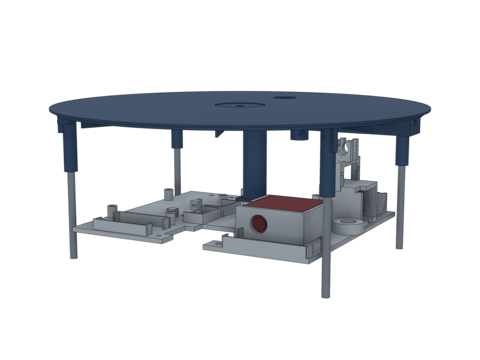
The Einzylinder looks like a top hat: a round hat body 250 mm in diameter with a flat brim of 340 mm that tapers thin towards the edge. The lower edge floats just 1 mm above the ground, so no opponent can get a scoop underneath it.
The trick lies in the interplay between the hat and the chassis. The hat can slide 25 mm up and down relative to the chassis beneath it. When an opponent drives onto the flat brim, a servo lifts the hat, and the opponent along with it. Its wheels lose traction, and then it can simply be pushed away. Anyone trying to grab the hat grabs thin air, because there is no edge to hook onto.
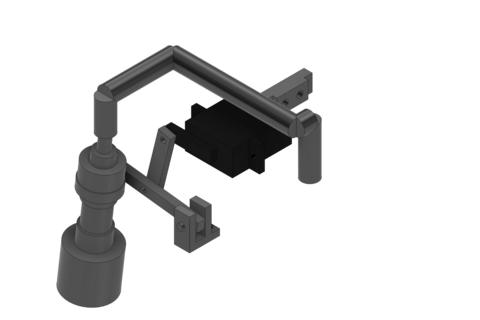
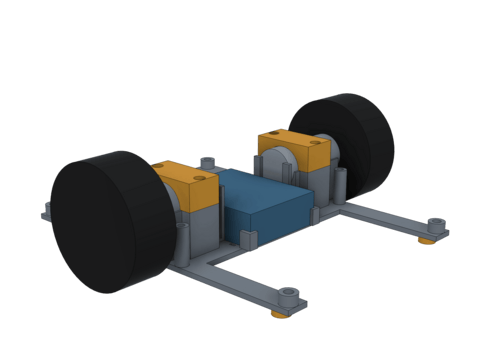
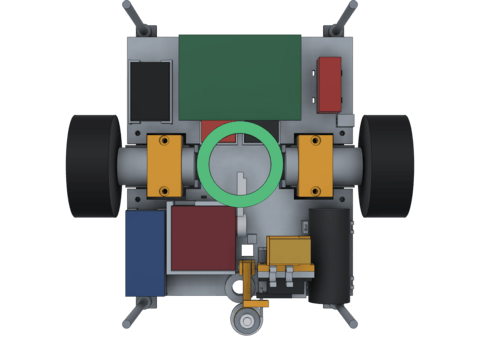
The following images are renderings taken straight from the Fusion 360 model. The colours only serve to tell the parts apart.
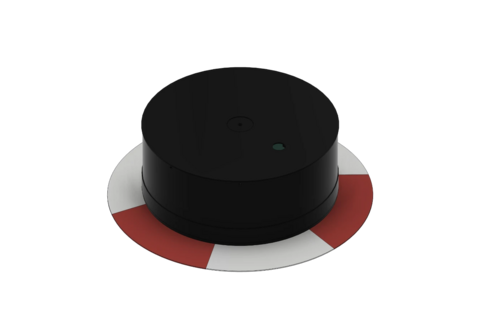
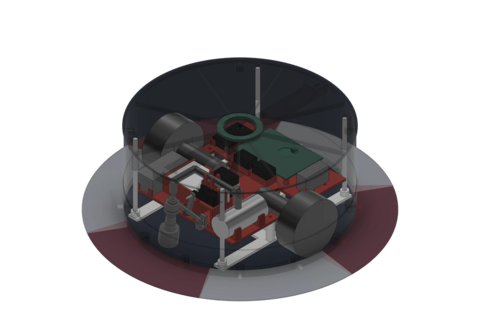
Two assemblies
- Hat: the hat body, six wedge-shaped brim segments (from 9 mm at the wall down to 1.2 mm at the edge) and a removable lid. The lid guides the hat on four pins and carries the main switch. I dropped a planned LED ring as a status indicator, because the main switch already lights up itself.
- Chassis: frame and upper deck with two motors in a differential drive, battery, board, pump and the servos.
All parts are cut so that they fit on a Prusa 3D printer with a 300 × 300 mm print bed. According to the model, the printed parts weigh around 690 g in total and the bought parts around 710 g. With cables and screws I had estimated about 1,440 g, only just below the 1.5 kg limit. In the end, the real bot came in at 1,352 g.
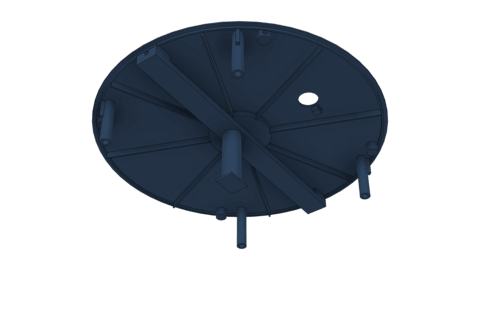
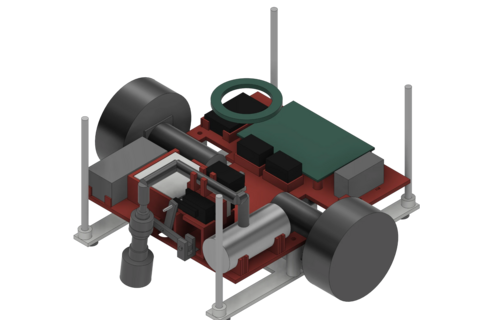
Technology
The lift
At first I wanted to lift the hat pneumatically. I abandoned that idea: the small 370 pump does not produce enough pressure to lift a hat plus an opponent. Instead, a strong servo (RDS3235) with an aluminium horn does the job. It turns by about 49°, pushes from below against a plunger on the hat lid and thereby raises the hat by 25 mm. Gravity brings it back down.
The guides are aluminium tubes running in printed plain bearings; they are fixed to the chassis with epoxy glue. The rods and bearings are treated with silicone spray to reduce friction.
The suction cup
That doesn't leave the pump out of work. It creates a vacuum for a spring-loaded suction cup on a swivel arm behind the deck, which a small MG90S servo presses onto the floor. The arm, bearing and linkage are separate printed parts, a hold-down keeps the servo in place, and a solenoid valve controls the venting. This module paid off in the competition, more on that below.
Drive and control
Two geared motors (JGA25-370, 60 rpm) drive wheels 68 mm in diameter, and the bot is radio-controlled with a MicroZone MC7RE (2.4 GHz, 7 channels). An ESP32 board reads the receiver's SBUS signal and drives the motors, while the lift servo is connected directly to the receiver. A step-down converter turns the 12 V of the 3S battery into 6 V for the servo, and an automotive blade fuse and a latching main switch protect the electrics.
The competition
In the preliminary round the Einzylinder held its own reasonably well. The last preliminary fight was close but didn't go my way, and so I missed the final round.
The suction cup had its big moment: in one fight my opponent already felt sure of pushing me off the table. Then the Einzylinder sucked itself onto the floor, and nobody had seen that coming. The suction cup saved me in that fight.
The King Loser round was great fun. In it, all bots that didn't take one of the top three places compete in the arena at the same time. The Einzylinder lasted until the very end and only had to give way to the Capibara forklift driver.
Conclusion
The lifting mechanism wasn't entirely convincing. Because everything was built a little too tightly, it couldn't reach its full potential. The suction cup, on the other hand, was the surprise of the day, at least for my opponents.

Designed with Claude
I designed the robot in Fusion 360, and not on my own: Claude worked directly in the model via an MCP connection. Collisions between the 48 bodies could be checked automatically, weights were estimated from the volumes, and a script exported the STL files. Especially for the details you would otherwise only notice during assembly (is the pump in the servo's way? does the horn clear the notch?), this saved a lot of test prints.
It didn't go entirely smoothly: once an undo ended up in the wrong document, and during the STL export some bodies silently produced no file at all. What I learned from that: check the active document before every delete and export a copy if needed.
What's next?
After Sumobot is before RescueBot: the next competition is coming up in spring. You can read how I got on at the last RescueBot in RescueBot 2026: FReD Takes the Win. And for the winter months in between, I already have the next idea for a robot. More on that later.
If you have ideas on how the hat could lift better next time, feel free to leave them in the comments. You can find information about the competition at sumobot.fablab-luebeck.de.


Comments (0)
No comments found!